How Were the Pyramids Built: What We Know for Sure and What Scientists Debate
How the pyramids were built is a question Egyptology has answered quite directly in recent decades. Quarries, tools, the builders’ village and even the diary of a man who shipped stone for the Great Pyramid have been found. The details are still debated — above all, exactly how the blocks were raised to the top. Below: what is known for sure, which theories scientists discuss and where to see it all with your own eyes.
From mastaba to pyramid: how old are the pyramids
The pyramid did not appear overnight. At first nobles were buried under mastabas — flat rectangular tombs. Around 2670 BC the architect Imhotep stacked six mastaba-like steps one on top of another for Pharaoh Djoser, creating the Step Pyramid at Saqqara.
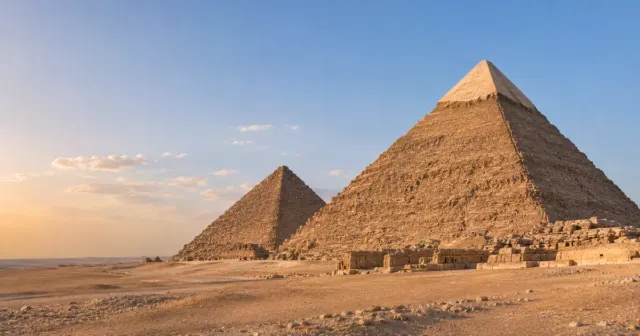
Then came trial and error. Pharaoh Sneferu built the Bent Pyramid at Dahshur, whose angle was changed halfway up — according to one theory, because of cracks in the structure. Next came the Red Pyramid, the first “true” smooth pyramid. His son Khufu (Cheops) used that experience to build the largest pyramid in history. More in “Dahshur and Saqqara” and “The Great Pyramid of Khufu”.
Where the stone came from
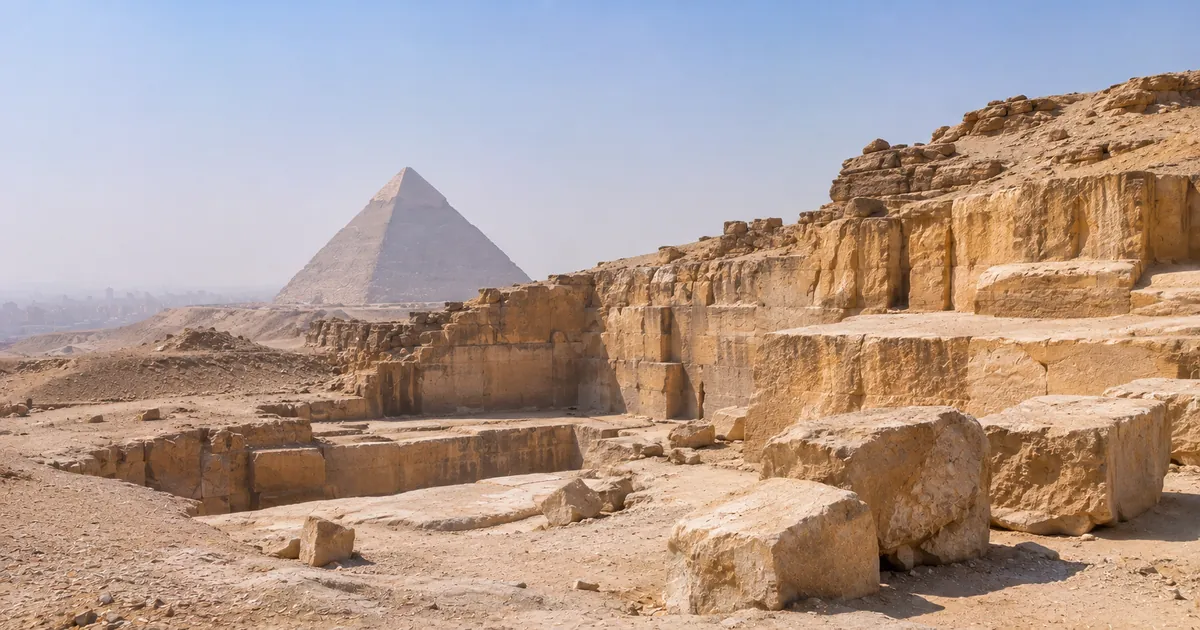
- Limestone for the core — right on the Giza plateau: the quarries are still visible, and the Sphinx was carved from the rock left behind.
- White casing limestone — from Tura, on the other bank of the Nile.
- Granite for the chambers — from Aswan, about 800 km up the Nile.
Stone was cut with copper tools, wooden wedges soaked in water and hard hammerstones. Copper saws with sand as an abrasive could cut even granite.
How the stone was moved along the Nile
The Nile was the main highway. In 2013 Egypt’s oldest papyri were found at Wadi al-Jarf on the Red Sea coast — the diary of an inspector named Merer. It describes how his team spent months shipping limestone from Tura to Giza by boat along the Nile and canals. The canals ran almost to the foot of the plateau, and in the flood season the water came closest of all.
How the blocks were lifted: scientists’ theories
This is the great debate among Egyptologists. The main theories:
- A straight ramp — a long embankment up one side. It works for the lower part, but for the top the ramp would have had to be enormously long.
- A spiral or zigzag ramp — wrapping around the outside of the pyramid or running up one face.
- An internal ramp — the theory of French architect Jean-Pierre Houdin: for part of the way the blocks went up a sloping tunnel inside the pyramid itself. Most Egyptologists treat it with caution.
- Levers — for raising blocks to the last courses, where there was no room for a ramp.
In 2018 a steep ramp with steps and post holes was found at the Hatnub alabaster quarry — a system for hauling blocks up with ropes. Researchers date it to about 4,500 years ago, which makes it technology from Khufu’s time.
Blocks were dragged on wooden sledges. A painting in the tomb of Djehutihotep shows a man pouring water in front of a sledge carrying a huge statue; in 2014 physicists showed that correctly wetted sand roughly halves the friction.
Who built the pyramids — slaves or Egyptians
The slave myth comes from the ancient Greeks and from the movies. Excavations by Mark Lehner and Zahi Hawass by the southern wall of the plateau uncovered a whole builders’ town: bakeries, breweries, living quarters and the bones of cattle used to feed them. Next to it is a cemetery with the tombs of craftsmen. Some skeletons show healed fractures: injured workers received medical care.
Egyptologists estimate that several thousand permanent craftsmen and up to 20,000–30,000 seasonal workers worked on the site, called up during the Nile flood when the fields were under water. The gangs had names such as “Friends of Khufu” — inscriptions like this survive inside the pyramid.
The mysteries of the pyramids, and why the alien myths are wrong
The Egyptians left plenty of evidence of construction: quarries with unfinished blocks, tools, papyri recording the work, gang inscriptions inside the Great Pyramid and the workers’ town. The genuinely open questions — exactly how the ramps ran, what the void above the Grand Gallery was for — are being answered by archaeology and physics. The pyramids impress precisely because people built them, with enormous organisation, mathematics and patience.
See the pyramids for yourself
The best way to grasp the scale is to stand at the foot of the Great Pyramid next to a bottom block almost as tall as a person. From Hurghada the pyramids are 5.5–6.5 hours by coach or about an hour by plane; from Sharm El Sheikh, 6–7 hours. Everything about the trip is in our Giza pyramids guide.
Entertainment · Cairo
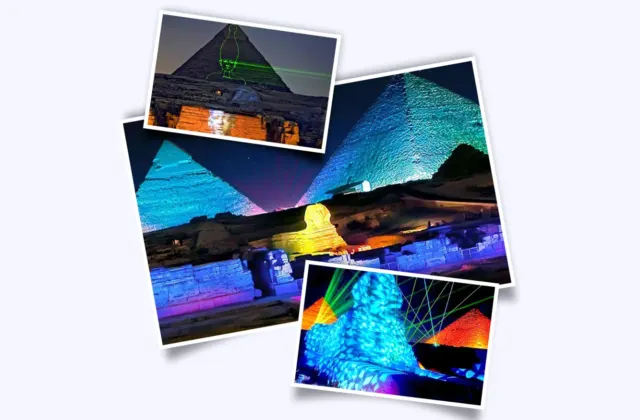
Sound and Light Show at the Giza Pyramids
- 2 hours
- Group
- Daily
Cairo & pyramids · Sharm El Sheikh
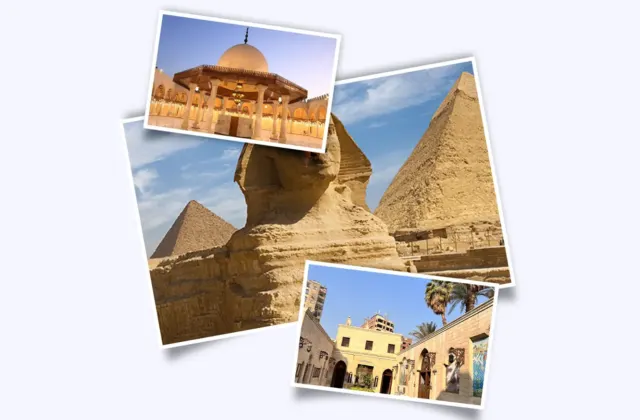
Cairo from Sharm El Sheikh in a Small Group: Pyramids, Tahrir Museum and Old Cairo
- 19 hours
- Small group
- Wed, Fri, Sun
- Kids friendly
Safari · Cairo
White and Black Desert in 2 Days from Cairo
- 2 days
- Group
- On request
- Kids friendly
If you want to add Saqqara and Dahshur to Giza and see the whole “evolution” of the pyramids in one day, a private trip is more convenient.
Cairo & pyramids · Hurghada
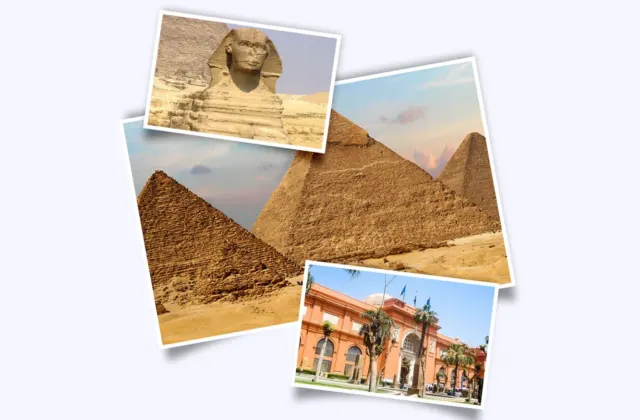
Private Cairo Tour from Hurghada
- 22 hours
- Private
- On request